
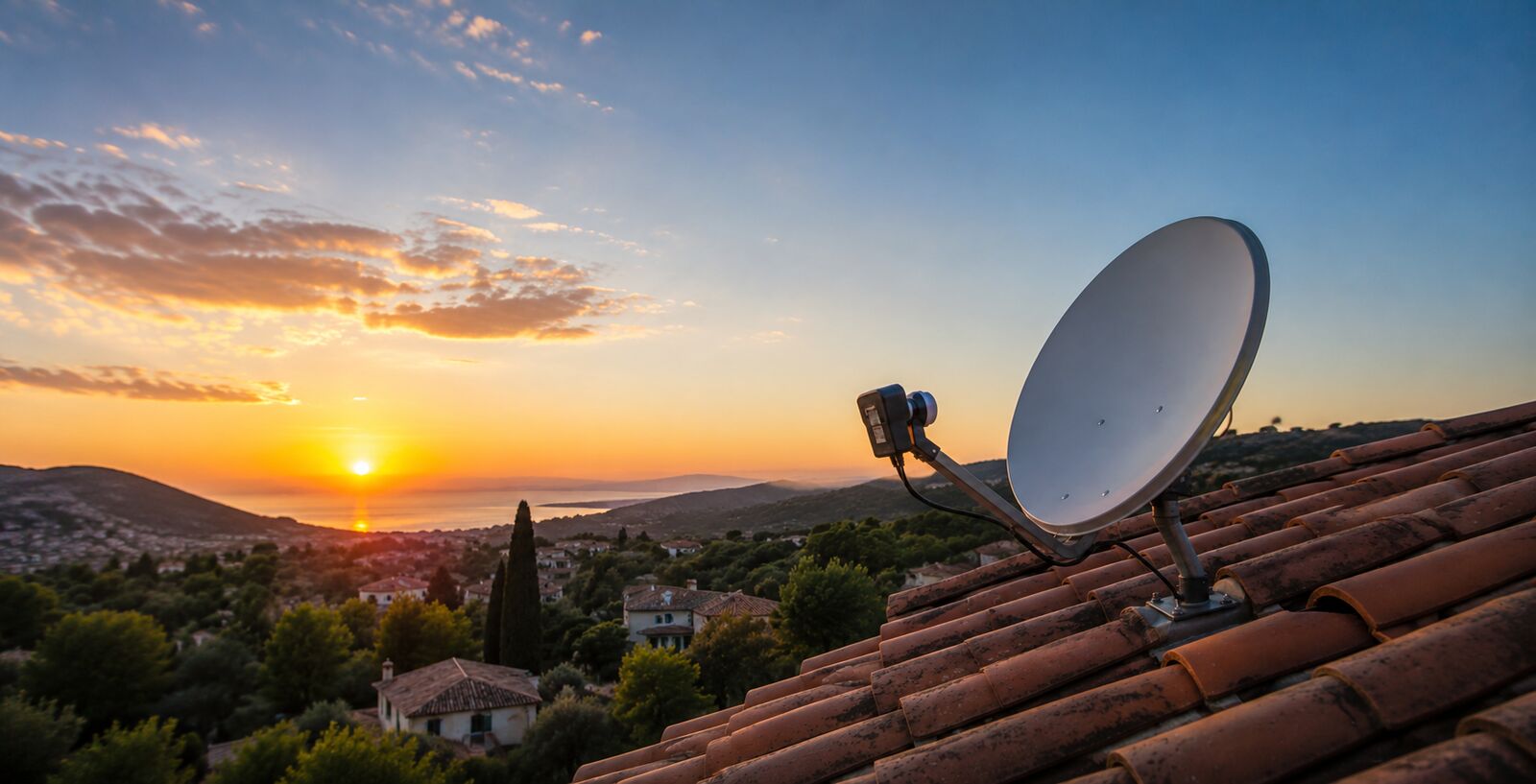
What is an LNB?
The LNB (Low Noise Block converter), also known as the "dish head", is the electronic component fixed at the end of the dish arm. It captures the signal reflected by the dish, converts it to an intermediate frequency and amplifies it before sending it to the receiver via the coaxial cable. It is an essential component of the satellite reception chain.
Signs of a faulty LNB
Several symptoms can indicate that your LNB has failed or is reaching end of life:
- Sudden total signal loss, with the dish position unchanged
- Unstable signal: the signal level fluctuates erratically
- Signal loss on a single polarity: some channels work while others do not (the LNB handles horizontal and vertical polarities)
- Signal loss on a single band: channels on the high band or low band disappear
- Pixelated picture that worsens in cold or damp conditions
- Receiver displays "LNB short circuit" or "no LNB voltage"
Causes of LNB failure
Electrical surge
A storm, even a distant one, can generate a power surge that destroys the LNB's electronic circuits. This is the most common cause of failure.
Water ingress
If the protective cover is cracked or the F connectors are not weatherproof, water enters the LNB and causes short circuits or corrosion.
Natural wear
An LNB has a service life of 5 to 10 years depending on quality and exposure. Over time, its performance degrades: gain decreases, noise increases, and reception becomes increasingly difficult.
UV exposure
The plastic casing of the LNB deteriorates under sunlight. It becomes brittle, cracks and no longer protects the internal electronics.
Our intervention
LNB diagnosis
Our technicians use a satellite field strength meter to precisely diagnose the condition of the LNB:
- Measurement of the supply voltage provided by the receiver (13V / 18V)
- Measurement of the current drawn by the LNB
- Signal verification on all four configurations: H/V polarity and high/low band
- Test replacement with a reference LNB
Replacement
Replacing an LNB is a relatively straightforward operation:
- Removal of the faulty LNB
- Installation of the new LNB (universal, twin, quattro or quattro switch depending on the installation)
- Fine adjustment of the LNB rotation angle (skew) to optimise reception
- Weatherproofing of the F connectors with self-amalgamating tape
- Full signal test across all satellite transponders
Choice of replacement LNB
We select the LNB most suited to your configuration:
- Single LNB: for one receiver
- Twin LNB: for two independent receivers
- Quad LNB: for four receivers
- Quattro LNB: for collective distribution via a multiswitch
- Monoblock LNB: for simultaneous reception of two satellites (Astra + Hotbird)
Preventing LNB failure
- Install a coaxial surge arrester on the cable run, before it enters the property
- Regularly check the condition of the LNB protective cover
- Ensure all external F connectors are weatherproofed
- Replace the LNB preventively every 7 to 8 years, before it fails
For any questions or additional information, you can reach us at 06 95 62 24 33, Monday to Friday from 9am to 6pm. Outside these hours, this line is reserved for emergencies, available 24/7.
Faulty LNB? We offer an emergency callout for a fast replacement.